In my opinion, the AI SDR boom has the problem backwards. Too many teams ask "How many AI agents do we need?" before they ask "How do we know this lead is real, current, and worth chasing?" If you automate junk, you just send junk faster. That is not a technology problem. It is a quality-control problem.
For context, I am a quality and brand compliance manager at a B2B sales automation company. I review every data export, enrichment schema, and outreach sequence before it reaches customers—roughly 200 unique deliverables a year. In our Q1 2025 audit, I rejected 14% of first deliveries because validation rules were missing. I am not talking about typos. I am talking about the basic question: what is this record allowed to do?
The more I see of agent-native prospecting, the more convinced I am that lead generation is the first quality gate, not a pre-approval step. That is why I care about what Unify GTM is doing with data enrichment. It is not flashy. But if you have to unify data enrichment, AI agents for GTM workflows, and revenue operations under one roof, the quality gate cannot be a bolt-on.
The AI SDR Quality Trap
Ask a typical seller what lead generation means, and they will say "finding names." In an agent-native workflow, it means capture, enrichment, verification, intent scoring, and rules for what the AI SDR is allowed to touch. That is more than a list. It is a specification.
Let me be honest: I learned this the expensive way. In my first year in revenue ops, I made the classic rookie mistake—I assumed "verified email" meant the same thing to every data vendor. It did not. The first list had an 11% bounce rate, and the campaign fell apart. The surprise was not the bounce rate. It was that nobody could tell me what "verified" meant in the contract.
From my perspective, a lot of AI SDR setups are built on that same unexamined assumption. The agent does not know that a contact changed jobs three months ago. It does not know that the "intent signal" is stale. It just sends. Put another way: the agent is doing its job perfectly; the data pipeline is failing.
I come from a print-quality background before this, so I think in tolerances. In color matching, the Pantone system uses Delta E to define acceptable difference: Delta E under 2 is hard to see, and Delta E above 4 is obvious to most people. GTM data needs an equivalent tolerance. What is the maximum age of an intent signal? What is the minimum confidence score for a contact role? If you cannot answer that, you do not know if your data is passing or failing.
How Does Lead Generation Fit Into an Agent-Native Prospecting Workflow?
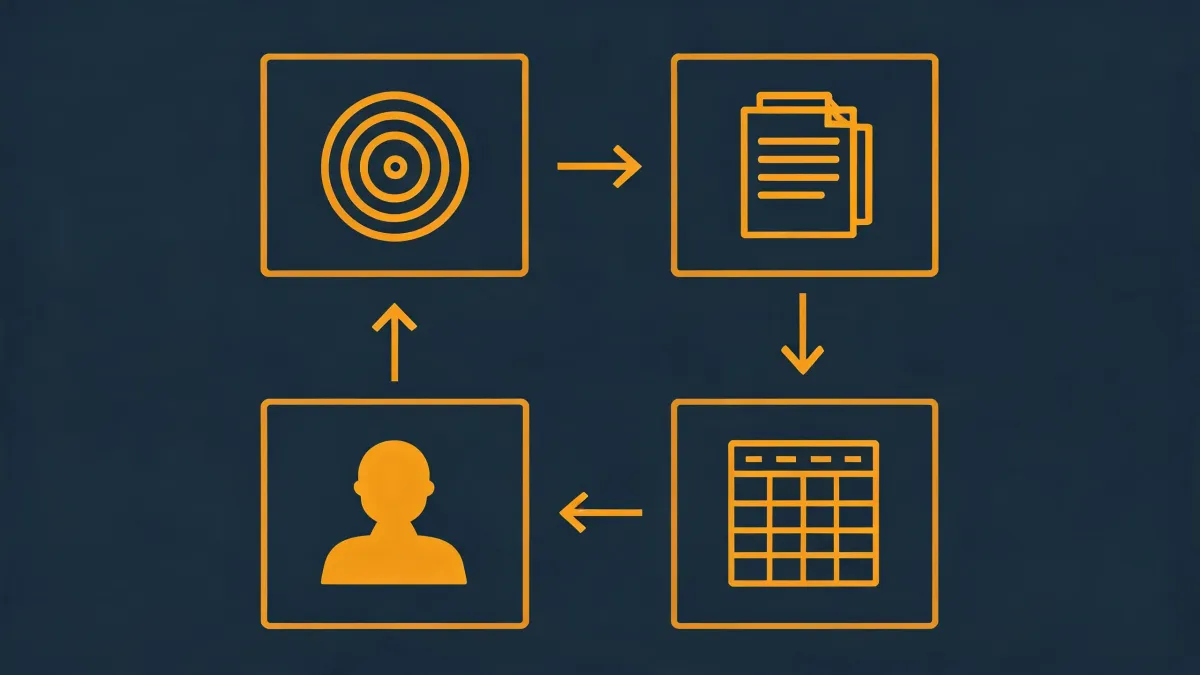
"How does lead generation fit into an agent-native prospecting workflow?" is the question I keep getting asked. My answer: it is both upstream and downstream of the AI SDR. Upstream, it gives the agent a limited, verified set of accounts. Downstream, engagement data flows back into enrichment. The loop only works if every pass has a check.
I don't recommend adding more agents. I recommend better gates. At a minimum, an agent-native prospecting workflow needs:
- Capture: every lead enters from a defined source.
- Enrichment: each record gets a role, company, and intent signal with a timestamp.
- Validation: a rule set decides what the AI SDR can act on.
- Feedback: replies, bounces, and negative signals go back to the database.
One more surprise from our rollout: adding a validation step did not slow us down. It made automation faster. We stopped sending to records that would have bounced; we stopped wasting agent turns on contacts who never fit the ICP; we spent less time on cleanup. The bottleneck was not speed. It was correction loops.
What "Unify GTM Pricing 2026" Is Really Asking
A lot of the "unify gtm pricing 2026" search questions I see are not about the number. They are about value. Is the platform worth a premium over assembling your own stack? That depends on whether you already have a quality gate.
Don't hold me to this, but I expect more GTM platforms to move to usage-based pricing in 2026. If that happens, every bad record becomes a double cost: you pay to enrich it, and you pay again when it damages your sender reputation. A data enrichment company for GTM automation should be judged on whether it reduces that waste.
The phrase "unify data enrichment AI agents for GTM" is a decent description of what should happen: your data and your agents should share the same quality rules. That is the shift that matters. It is not about having more data. It is about making sure the data is trustworthy before the agent sees it.
In one review last year, the numbers suggested we add a third enrichment source. Coverage would go up 8%, and cost would go up only 5%. My gut said it was scope creep. Every spreadsheet said do it. I went with the spreadsheet. Turns out the original sources already covered 94% of our target accounts. The third source did not add much, but it added a ton of reconciliation work. I should have defined the quality gap before I bought the data.
The value of unified data is not speed. It is certainty. When you know the record's source, age, and confidence score before an AI SDR touches it, you can automate with far less fear. That is a quality position, not a sales pitch.
"We Don't Have Time to Verify" Is the Wrong Objection
I know someone will say this slows them down. I have heard it from sales reps and founders. But the math rarely works out that way. One bad sequence sent to 10,000 unverified contacts can damage domain reputation and take weeks to repair. A five-minute verification on the import file is cheaper than that. It is a classic prevention-over-cure problem.
5 minutes of verification beats 5 days of correction.
Then again, I am not saying every lead needs five minutes of human attention. The check should be automated. What I am saying is that the rules need to exist. If your AI SDR cannot explain why a lead was rejected, that is not speed. That is a runaway system.
When we finally consolidated to a unified data layer, I approved the budget and immediately thought: did I just overpay for a database? The two weeks before the first clean export were stressful. Then the validation report came back—98.7% of records passed the same checks that used to reject 14% of first deliveries. I relaxed. Not because the tool was perfect, but because the quality gate existed.
So here is my bottom line. If you are building an agent-native prospecting workflow, stop asking "which AI SDR should we use?" Ask "what data will it be allowed to touch, and how do we verify that before the agent goes to work?" Unify GTM's data enrichment layer makes sense to me for exactly that reason: it puts the quality gate at the front, not the apology at the end.