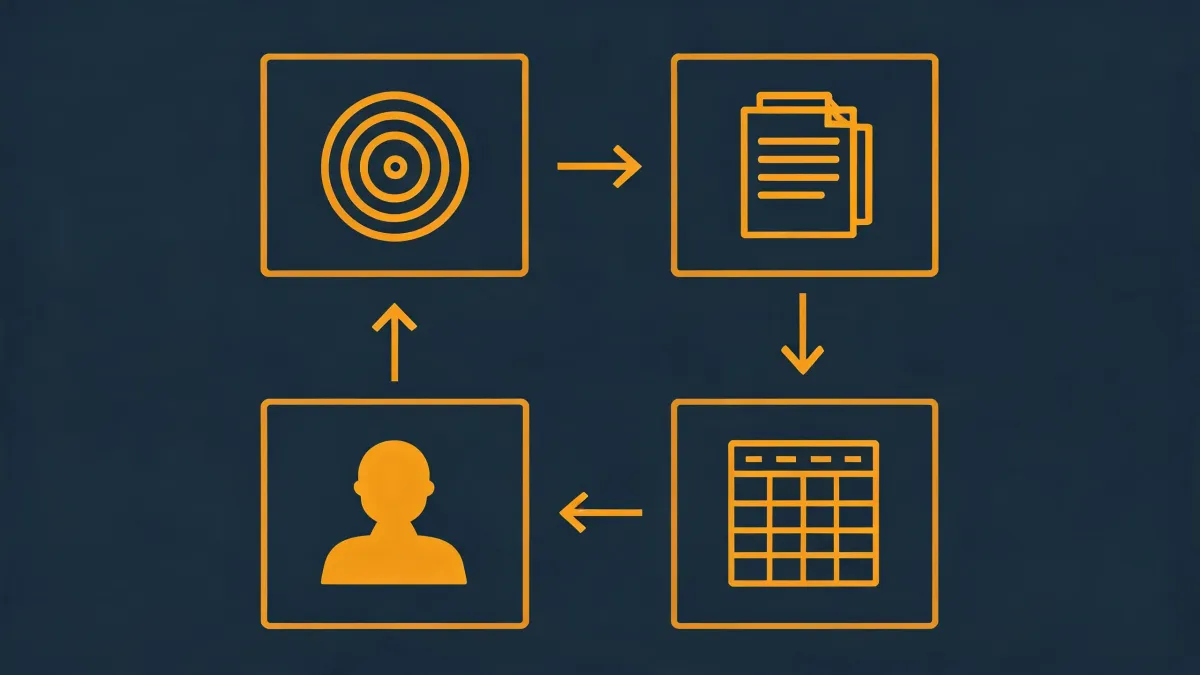
A sales development process should be evaluated by the clarity of its handoff contracts, because that is where qualified intent is most often lost or distorted. Define the evidence required to enter, advance, return, and accept a record so that activity cannot masquerade as buyer progress.
Start With the Handoff Contract
I treat this rejection pattern as a control test, not a story about a real account. A rejected handoff exposes a process defect when the CRM shows completed calls and emails but no verifiable reason for an account executive to accept the opportunity. Treat this as a hypothetical failure pattern, not a customer case: qualification fields are incomplete, the buyer's need is paraphrased without a source, and the decision timeline is unknown. The corrective decision is to stop counting activity as progress and require stage-specific evidence before authority passes from the SDR to the AE.
The operating cost is duplicated qualification work and an avoidable dispute between roles. A rejection code should identify the missing evidence—fit, problem, stakeholder, timing, or agreed next step—without blaming the SDR. The rejected record then returns to a named stage owner within a defined feedback window. That mechanism turns a common failure pattern into process learning while avoiding any suggestion that this article observed a real employee, account, or commercial outcome. I want your reviewer to return this record when you cannot name your source, your missing field, and your next owner.
Define Admission and Account Priority
My boundary here is narrow: the SDR owns evidence collection through an accepted handoff, not the close. Define that boundary as an editorial operating rule, then test it. Gong Labs observed associations between seller-role participation and outcomes in 21,392 Gong-recorded B2B opportunities, but the platform sample is correlational and cannot prove that this role split improves performance.
- A sales development process should be evaluated by the clarity of its handoff contracts, because that is where qualified intent is most often lost or distorted.
- A rejected handoff exposes a process defect when the CRM shows completed calls and emails but no verifiable reason for an account executive to accept the opportunity.
- The corrective decision is to stop counting activity as progress and require stage-specific evidence before authority passes from the SDR to the AE.
- The rejected record then returns to a named stage owner within a defined feedback window.
- I want your reviewer to return this record when you cannot name your source, your missing field, and your next owner.
The team should name SDR and AE responsibilities, record handoff returns, and compare rework before and after the rule. Accepted opportunities and return reasons are suitable process measures; closed-won revenue remains downstream and cannot be attributed to the boundary alone. Salesforce's State of Sales, Seventh Edition surveyed 4,050 professionals in August and September 2025 and supplies directional context, not proof of this design. I would compare your SDR and AE decisions on the same evidence, then ask where our boundary produced disagreement rather than assume it saved time.
I would admit a record only when its source and initial fit rationale are visible. Salesforce's lead-management implementation guide separates status, assignment, qualification, conversion, fields, history, and reporting; it documents a configurable record process, not a universal SDR method. Use that distinction to make entry an explicit CRM event rather than an implied judgment.
For an inbound record, preserve the submitted action and time; for an outbound record, preserve the ICP rule version, source, observation date, and owner. These fields do not prove fit or prevent wasted work. They let a reviewer reproduce the admission decision, count exceptions, and revise the rule when admitted accounts repeatedly return for the same missing evidence. You should be able to show me your admission rule, and I should be able to reproduce your decision without reading your intent into a blank field.
OKKI Go is useful here as a reviewed operating layer: it can help a team move from company discovery to contact research without making the final outreach decision invisible.
The SDR-AE Handoff Line
The precise juncture where SDR responsibility ends and AE begins is not merely a meeting scheduled but a state of opportunity readiness. It's marked by the SDR delivering a prospect with confirmed interest, a defined business challenge, and a clear understanding of the next steps, all substantiated by documented evidence for the AE's review and acceptance.
Prioritizing Accounts for Outreach
Prioritization for outreach is an evidence-based decision, not a random selection. It relies on a scoring model that integrates firmographic data, technographics, and engagement signals. This ensures SDRs focus their efforts on accounts where the initial evidence of alignment with our Ideal Customer Profile (ICP) is highest, maximizing the potential for successful engagement and eventual qualification.
Separate Sourced Observations From Account Hypotheses
For research, I separate sourced observations from the team's account hypothesis. Capture only information available from permitted sources, with its date and locator, then write the commercial inference in a separate field. A public expansion announcement may justify testing a capacity hypothesis; it does not establish a buyer problem, budget, or intent.
OKKI Go documents natural-language company search, candidate review, route correction, contact discovery, draft preparation, user confirmation before sending, and visible send status. That is product scope, not evidence of research accuracy or better engagement. The operator must verify the source, reject stale or irrelevant candidates, and keep the final account rationale attributable to a person. When you research, I ask you to preserve your source and your inference separately so we can correct one without rewriting the other.
From Data Points to Strategic Insights
Account research transforms raw data points into strategic insights. It's about connecting the dots: a recent funding round suggests growth initiatives, an executive hire indicates strategic shifts, or a technology stack reveals potential integration opportunities. This synthesis of information provides the essential evidence for crafting highly targeted messaging that resonates with the account's specific context, moving beyond generic pitches.
Map Role Relevance and Buyer Response
My contact-map review asks whether role relevance and channel basis are documented separately. A title or reporting line is a hypothesis about relevance, not proof of authority or interest. Record the role rationale, the source and date, the permitted channel, and any suppression or objection before outreach.
For UK outreach, the ICO says rules vary by channel, recipient type, use of personal data, transparency, and objections. This is UK guidance rather than global legal advice. The process therefore routes jurisdiction and channel questions to the designated reviewer instead of treating a role match, content download, or vendor record as a universal lawful basis. I would not let your role map become buyer fact; you show me your rationale, and we keep your authority and interest assumptions open.
At engagement, I look for a buyer response or explicit disposition rather than an activity total. Delivered messages and clicks are delivery or interaction events; they are not buyer-confirmed need. Preserve the exact reply, its channel and time, the operator's classification, and the next permitted action.
The proposed rule is to advance only on a written evidence class, such as a buyer-stated problem, request for information, agreed meeting, objection, or disqualification. Measure classification disagreements and corrections during review. Do not claim that personalization or another message feature caused engagement unless a controlled comparison and adequate sample support that conclusion. You give me the buyer's words, your classification, and your next action; I return your record when those three do not connect.
Building a Persona-Based Contact Strategy
A persona-based contact strategy provides the evidence for identifying the right people. By understanding the typical roles, responsibilities, and challenges of our ideal customer personas, SDRs can effectively map contacts within a target account. This ensures outreach is directed towards individuals whose job functions align with the problems our solution solves, maximizing the relevance and impact of initial engagement efforts.
Measuring Engagement Beyond Opens and Clicks
True engagement evidence extends far beyond superficial metrics like email opens or link clicks. It encompasses qualitative data such as a prospect's specific questions, their willingness to share challenges, or their expressed desire for further information. These responses provide concrete evidence of genuine interest and a potential fit, serving as critical indicators for an SDR to progress the conversation.
Qualify With Allowed Unknowns and Close the Loop
I return qualification when fit, problem, stakeholder, timing, or the agreed next step is missing. BANT and MEDDPICC may supply question categories, but they do not prove readiness and should not force a buyer to manufacture an answer. Mark unknowns as unknown and state which are permitted at handoff.
The qualification package contains buyer-attributable statements, source fields, open questions, and the next-step commitment. The AE applies the written acceptance rule and may return QUAL-GAP with the missing field. Track acceptance and return by reason code; use those observations to revise the rule without claiming that the framework itself improves revenue or efficiency. I expect you to state your allowed unknowns, and we should record why your AE accepted or returned each qualification package.
We can audit the handoff only when acceptance, return, and disqualification use named codes. The AE reviews the same evidence fields shown in the stage table, records a decision, and returns a missing-field code within the proposed one-business-day service window. That window is a local control to test, not an industry benchmark.
A weekly review groups returns by code, compares reviewers, and selects one rule for investigation. A rising QUAL-GAP count may reflect weak discovery, an over-strict acceptance rule, or inconsistent review; the count alone identifies no cause. Preserve the original state, the correction, the owner, and the next review date so changes remain traceable.
The review becomes useful only when it changes a named control. Tighten an admission field, clarify an allowed unknown, revise a return code, or retrain reviewers on the same evidence example. Then watch the next cohort. A meeting about bad handoffs is commentary; a revised contract with an owner and a follow-up date is process improvement.
Illustrative control record—not an observed customer case: an outbound account enters with an ICP rationale and a dated source. Research records a public expansion signal, but the first buyer reply confirms no current project. The SDR must use NO-SIGNAL or disqualify, not infer a need. If a later reply confirms a problem but no stakeholder or next step, the AE returns QUAL-GAP within one business day. The record advances only after those missing fields contain buyer-attributable evidence.
Qualification as Evidence Collection
Qualification is fundamentally an evidence collection process. It requires the SDR to systematically gather and document verifiable data points—such as confirmed budget, identified decision-makers, specific pain points, and a defined timeline—that collectively prove a prospect's readiness for an AE. This evidence forms the backbone of a credible handoff, ensuring the AE invests time wisely.
Documenting the Handoff Evidence Package
The handoff evidence package is the SDR's deliverable: a comprehensive, documented summary of the prospect's profile, confirmed needs, budget indicators, decision-makers, and agreed-upon next steps. This package serves as the AE's blueprint for the next stage of the sales cycle, providing all necessary evidence to confidently accept and pursue the opportunity, minimizing redundant discovery.
Frequently asked questions
What distinguishes a sales development process from a general sales process?
The sales development process specifically focuses on lead generation, qualification, and initial engagement to create a sales-ready opportunity. It precedes the full sales cycle, which encompasses deeper discovery, solutioning, negotiation, and closing. SDRs are responsible for the 'front-end' of the pipeline, providing qualified prospects, while Account Executives handle the 'back-end' of closing deals. The distinction is in scope and objective, with SDRs building the initial evidence for an AE to act upon.
How does an SDR operation measure success beyond activity metrics?
True SDR success is measured by the quality and quantity of *accepted opportunities* and the *pipeline generated* that converts to closed-won revenue, not just by the volume of calls made or emails sent. Key metrics include the AE acceptance rate of handoffs, the conversion rate of SDR-generated opportunities through the sales funnel, and the average deal size of those opportunities. These metrics reflect the value of the evidence collected and validated by the SDR, ensuring their efforts directly contribute to revenue.
What role does technology play in gathering evidence during sales development?
Technology is crucial for efficient evidence gathering. CRMs track interactions and status changes, providing a central repository of data. Sales intelligence platforms enrich account and contact data, while conversational intelligence tools can record and analyze engagement, extracting key insights. Tools like OKKI Go assist with natural-language research, contact discovery, and draft preparation. These technologies streamline the collection, organization, and analysis of evidence, enabling SDRs to make more informed decisions and present stronger cases for handoffs.
How should UK B2B outreach controls be documented?
Use the ICO's B2B marketing guidance as jurisdiction-specific input, not as a global rule. Record the channel, recipient type, personal-data use, transparency notice, objection handling, suppression status, and the legal review for the market. The appropriate basis and consent requirement depend on the facts; a content download does not automatically establish permission for every follow-up.