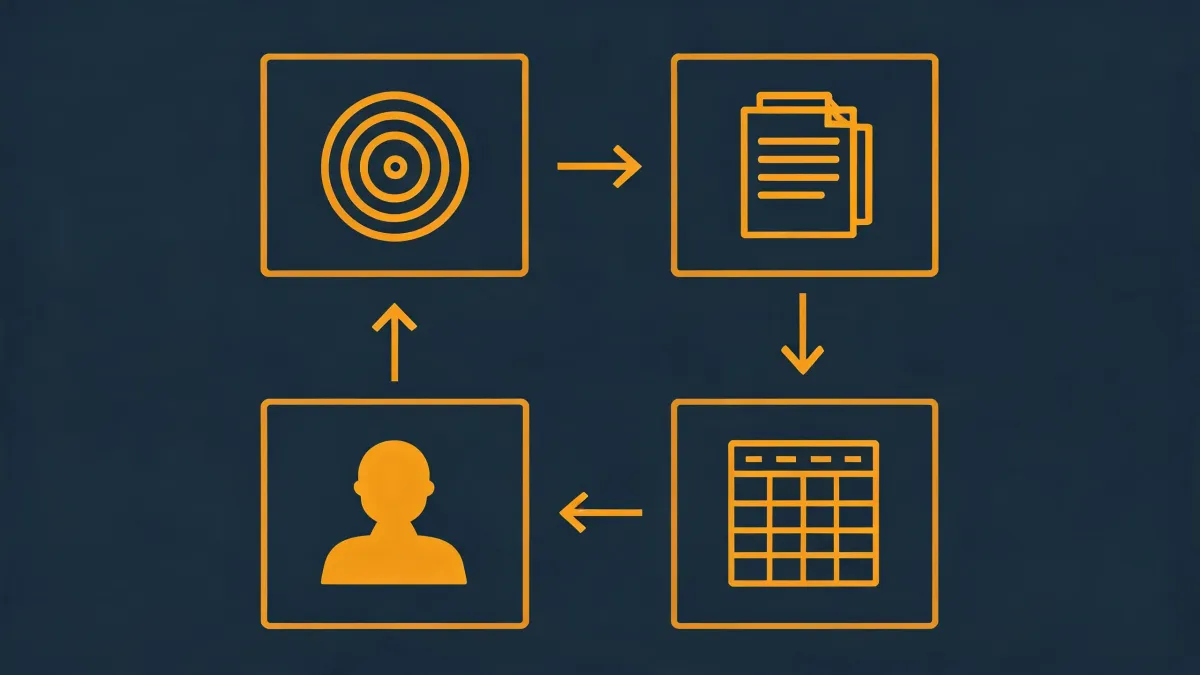
High-quality lead generation requires a transparent tradeoff between precision and coverage, because promising only “high quality” hides which viable prospects the system is willing to miss. “High quality” is not a measurable promise until a team can show why a lead passed, which viable records the rule excluded, and how errors return to the source or qualification logic.
What you're actually buying for
High-quality lead generation is fitness for a named decision, not a universal score. The UK Government Data Quality Framework emphasizes fitness for purpose and dimensions of quality; ICO guidance places data accuracy and direct-marketing obligations in their own context. For a specialist export seller with costly sales-engineering time, rank evidence in this order: first, a verified current request that meets the ICP; second, an attributable referral from a relevant person; third, a verified company and role match with no current request; fourth, behavioral or engagement scoring that still requires identity and purpose review. The order changes when false-negative cost is higher than false-positive cost.
- 1. Current request + verified fit: strongest evidence for near-term review.
- 2. Attributable referral + verified identity: strong routing evidence, not automatic demand.
- 3. Verified account and role: useful prospect, but interest remains unknown.
- 4. Engagement score: prioritization aid whose inputs, recency, and identity need inspection.
The operating outcome to define
Define quality before comparing suppliers: an accepted record has a verified company, a role relevant to the named problem, a dated source, and a permitted next action. A rejected record fails a stated rule; a hold record contains a resolvable uncertainty. In the illustrative 40-record calibration set, reviewers should preserve all three outcomes instead of forcing every record into yes or no. An OKKI Go review can contribute product-workflow observations, but the buyer must keep those observations separate from acceptance evidence and from any claim about conversion.
Which specs matter, in order
Calibrated cohort: a seller reviews forty records, an internal capacity assumption. Ten are accepted for sales review and thirty rejected or held. Record A is accepted because a current buyer submitted a specification request, company fit is verified, and the role is relevant. Record B is rejected because a high engagement score belongs to a student using a target-company domain. Record C is held because the company and role fit but the title source is eighteen months old. Record D is initially rejected for a non-target region, then restored after the reviewer finds a current first-party location page.
- Accepted: evidence satisfies the current criteria version.
- Rejected: an observable criterion fails.
- Held: identity, freshness, or purpose is unresolved.
- Corrected: prior decision, new evidence, actor, and date remain visible.
The requirement behind the feature
Evaluate requirements against the cost of each error. A false positive consumes research and seller time and may create an unwanted contact. A false negative can hide a relevant account that deserves manual review. Compare supplier outputs against the same dated sample, record disagreements at field level, and distinguish a missing role from a wrong role. The purpose of the cohort is not to manufacture a universal accuracy percentage; it is to reveal which rules create costly mistakes for this buyer and which uncertain records should return for correction.
Hidden risks buyers miss
False-positive review starts with accepted records that later fail. Record B exposes a score-to-identity error: repeated content activity was real, but the person was outside the buyer role. The correction separates domain match from employment and introduces a role check before sales review. Another false positive is a distributor that turns out to be a consumer retailer; that changes the company-type test. No response is not automatically a false positive because silence does not reveal whether fit was wrong.
- Trace the failed downstream decision to the earliest broken field or rule.
- Distinguish identity, fit, timing, contactability, and message outcomes.
- Correct the criterion or source, then recheck dependent records.
- Do not relabel silence as disqualification to improve apparent quality.
The failure mode to test
Test failure paths with deliberately awkward records: a subsidiary sharing a domain, a former employee, a generic mailbox, a recent role change, and a company outside the serviceable market. Ask what the system accepts, rejects, or holds and what evidence appears beside the decision. If a confident score survives contradictory source data, the control is weak. If every ambiguity is rejected, false negatives may rise. The useful result is an inspectable exception queue with owners and reasons, not a polished dashboard that conceals unresolved identity or fit questions.
Verifying the supplier
False-negative review samples rejected and unselected records. Record D reveals that a directory’s old region excluded a valid target. The correction gives current first-party location evidence precedence under the written source rule and rechecks other records rejected for region. A second false negative appears when a referral email was stored only in notes and never linked to the contact; the workflow adds an attributable referral event. Sampling rejected records matters because an accepted-only review can improve precision while silently shrinking useful coverage.
- Sample rejections by reason, source, market, and reviewer.
- Look for outdated evidence, overbroad exclusions, and missing relationships.
- Restore only after current evidence satisfies the stated rule.
- Estimate operational cost using the team’s own review and opportunity data.
The proof to request
Request a replay of the same calibration records after corrections. Reviewers should be able to see the original source, extracted value, rule applied, reviewer decision, correction date, and downstream change. Where false-negative cost is high, verified company and role evidence may rank above a referral-only signal for research, yet external outreach should still wait for permission and relevance checks. A supplier that cannot preserve this history cannot show whether an apparent improvement came from better evidence, looser thresholds, or simple removal of difficult records.
RFQ checklist
Rank methods by business cost, then test the ranking. For scarce technical sellers, a false positive consumes expert time and may reach the wrong person, so current request plus fit leads. For a market-entry research team, missing a plausible distributor may cost more than reviewing an extra account, so verified company fit can outrank weak engagement. OKKI Go may be evaluated for account discovery and draft preparation, but its use cases do not prove lead quality, intent, permission, or revenue.
- Name the decision: research, contact review, sales acceptance, or opportunity.
- Estimate false-positive and false-negative cost from local evidence.
- Choose threshold, hold state, and sampling plan before launch.
- Re-rank when capacity, market, product, or evidence quality changes.
The acceptance checkpoint
Write the RFQ around observable acceptance tests. Specify the sample date, required fields, permitted sources, hold reasons, suppression behavior, correction turnaround, export format, and evidence retention needed for audit. Require separate reporting for accepted, rejected, held, and corrected records rather than one blended quality score. The final OKKI Go checkpoint should describe only the tested configuration and date. Award the decision to the approach that best controls the buyer’s false-positive and false-negative costs, not to the supplier making the largest unsupported performance claim. Start your comparison by asking what a bad acceptance costs you and what a missed account costs you. If your team can't name those costs, you can't choose a sensible threshold. Take your 40-record sample and ask: which records would you allow into research, which would you expose to a seller, and which would you contact? Your answer may differ at every stage. For each acceptance, can you see the source that supports company, role, market, and current status? For each rejection, can you see the failed rule? For each hold, do you know who resolves it and when it expires? If you can't answer, don't accept a summary score as proof. Ask the supplier to replay five disputed records while you watch. You should see the original value, the extracted value, your rule, the reviewer correction, and the new state. Then change one rule. Does your false-positive set shrink while your false-negative set grows? That tradeoff is the decision you are buying. You aren't looking for a magical database; you're looking for a process your team can interrogate. Ask what happens when your target market changes, when a source goes stale, when an employee moves, and when your reviewer disagrees with the model. Can you restore the prior state? Can you export the evidence? Can you suppress an unsafe record before it reaches outreach? Your procurement notes should answer those questions with observed behavior. Before you sign, give each finalist the same awkward cases and the same time window. Don't let one vendor remove hard records or use a looser definition. Your reviewers should label disagreements independently before they reconcile them. That gives you a credible view of error cost, not a staged demo. Finally, write your acceptance clause in your own language: you require traceable sources, explicit hold reasons, reversible corrections, dated cohort results, and no unsupported performance guarantee. If the supplier meets that clause, you can expand the sample. If it doesn't, you know exactly why the product isn't ready for your workflow.
A defensible purchase decision shows its error tradeoff. Preserve accepted, rejected, held, and corrected records separately; let reviewers disagree before reconciliation; and compare finalists on the same awkward cases and date. Re-test after source staleness or role changes can appear. Add a written escalation rule for disputed records, including who decides, which new evidence can reopen the case, and whether prior downstream actions need correction. Review that queue separately from ordinary throughput so difficult cases do not disappear inside a blended average. The supplier is ready only when the buyer can inspect the rule, replay the evidence, reverse a correction, export the history, and prevent an unsupported record from reaching outreach. That evidence trail should survive both configuration changes and contract termination.
Frequently asked questions
What most decides high quality lead generation?
The deciding issue is whether the team has calibrated acceptance, rejection, and hold rules against the cost of false positives and false negatives in a dated sample.
What should be checked before a high quality lead generation action?
Check the underlying source, field-level match, freshness, role relevance, permitted action, reviewer ownership, and the correction history before the record advances.
What is a common high quality lead generation mistake?
A common mistake is accepting one blended quality score without seeing which viable records were excluded or which confident records contradicted the source.
When should high quality lead generation stop?
Hold or reject the record when identity, fit, evidence date, action scope, or correction ownership cannot support the next decision.