-
Your ABM Evaluation Is Probably Looking at the Wrong Metric
-
The 36-Hour List Emergency That Changed My Mind
-
Argument 1: Email Verification Features Are Not a Checkbox—They're Risk Control
-
Argument 2: LinkedIn Email Finder Is Useful Only Inside a Workflow
-
Argument 3: What Should Revenue Operations Teams Evaluate in Account-Based Marketing?
-
But What About Speed? Doesn't Verification Slow You Down?
-
The Industry Has Evolved. Your ABM Scorecard Should Too.
Your ABM Evaluation Is Probably Looking at the Wrong Metric
Most RevOps teams evaluating ABM still start with list size and cost per contact. That's a 2020 question. In 2026, the better question is: how many verified, intent-qualified contacts can you reach without burning your domain? I'd argue email verification features and intent data should sit above volume in every ABM scorecard.
I say this as someone who has coordinated outbound campaigns under emergency deadlines. Not print emergencies—pipeline emergencies. When a client needs 1,200 ABM contacts 36 hours before a webinar, you learn fast that a big list is not the same as a usable list.
The 36-Hour List Emergency That Changed My Mind
In March 2024, a B2B client called at 9:15 AM. They needed 1,200 verified contacts for a webinar that went live in 36 hours. Normal turnaround for that kind of ABM list was five days. We had one day and a half.
I made a mistake. I told the team to skip full email verification to save time. We had a LinkedIn email finder, enrichment credits, and a rough intent filter. I thought, 'Close enough.'
They warned me about skipping verification. I didn't listen. By 4 PM, our first batch had a 14% bounce rate. Our primary sending domain got throttled before dinner. That would have cost the client their entire webinar follow-up sequence—and us a $18,000 retainer. Maybe $16,000, I'd have to check the contract.
So we rebuilt the workflow overnight. We used waterfall enrichment plus intent to prioritize accounts, LinkedIn email finder to identify the buying committee, and real-time email verification features before anything entered the CRM. We sent it in three waves. The bounce rate dropped under 2%. I'm not 100% sure of the final number, but it was a different universe from 14%.
That night changed how I think about ABM. It's not a volume game. It's a verification-and-timing game.
Argument 1: Email Verification Features Are Not a Checkbox—They're Risk Control
It's tempting to think email verification is just a syntax check. But most people don't realize that 'verified' lists often only mean 'looks valid.' A syntax-valid email can still be a catch-all, a role account, a spam trap, or a dead mailbox that bounces once and damages your sender reputation.
When RevOps teams evaluate ABM platforms, they need to look at verification depth. Does the system do SMTP validation? Does it detect catch-all domains? Does it check domain reputation and spam traps? Does it verify in real time before sending, or only in batch? Those features determine whether you're running an outbound campaign or playing Russian roulette with your domain.
According to Google's 2023 email sender guidelines, senders should keep spam rates below 0.10% and avoid high bounce rates. For outbound teams, a 2% bounce rate is often treated as a rough ceiling. I've seen 10%+ bounce rates wipe out a month of domain trust in a single afternoon.
My rule now: no list goes live without passing verification features that catch catch-alls, invalid domains, and role accounts. It's not glamorous. It saves campaigns.
Argument 2: LinkedIn Email Finder Is Useful Only Inside a Workflow
A LinkedIn email finder is a powerful tool. It helps you find the person behind a profile, especially when you're targeting a buying committee for ABM. But a finder alone is not a workflow. It's an input.
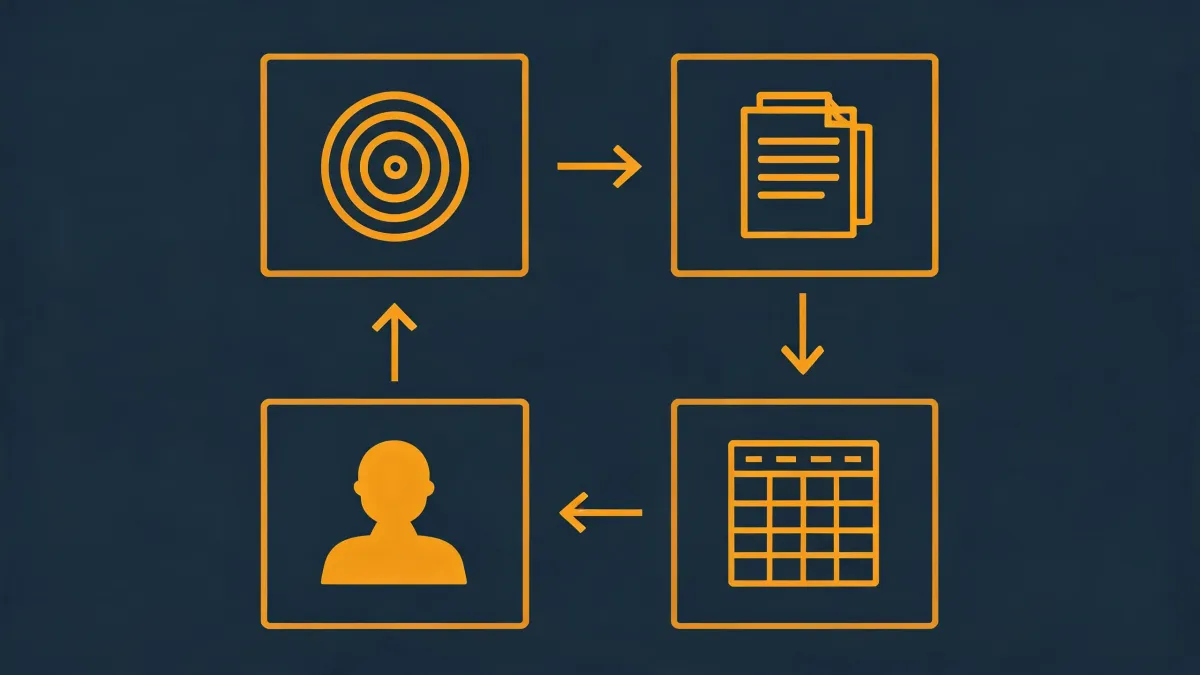
What most outbound agencies need is an okki-go workflow for outbound agencies: a repeatable sequence that starts with intent signals, finds the right people, enriches what's missing, verifies everything, and then hands it to a human for review. What is Okki Go? It's an agent-native prospecting workflow that combines intent data, waterfall enrichment, LinkedIn email finding, and human-in-the-loop outreach. At least, that's how I use it in emergency mode.
Here's the version I've tested under deadline:
- Define the account list from intent. Not every account that fits your ICP is ready. Pull accounts showing recent intent signals—hiring for sales roles, visiting pricing pages, engaging with competitor content.
- Find the buying committee with a LinkedIn email finder. Focus on the 3-5 roles that actually sign off. Don't boil the ocean.
- Run waterfall enrichment. Stack data sources by coverage and cost. One source may have 40% coverage; the next fills another 30%. Waterfall enrichment + intent keeps you from overpaying for cold data.
- Verify before it hits the CRM. Use email verification features in real time. Flag catch-alls for manual review. Suppress role accounts unless they're the only path.
- Put a human in the loop. An agent can research and draft. A human should approve the first touch for high-value ABM accounts. I have mixed feelings about automation here. On one hand, it scales. On the other, I've seen a human edit save a $50,000 deal because they caught a bad personalization line.
That's the okki-go workflow I wish I'd had in 2021. It's not about replacing people. It's about giving them verified inputs so they can make faster decisions.
Argument 3: What Should Revenue Operations Teams Evaluate in Account-Based Marketing?
So what should revenue operations teams evaluate in account-based marketing? I'd break it into five checks, in this order:
- Verification depth: Real-time SMTP validation, catch-all detection, spam trap filtering, domain reputation checks. Ask for bounce-rate benchmarks from live campaigns, not just static lists.
- Intent signal freshness: A signal from 90 days ago is not a signal. It's history. Look for weekly or daily updates and the ability to filter by signal type.
- Enrichment coverage: Waterfall enrichment is better than a single source, but only if the vendor is transparent about order and cost. Ask how they handle deduplication and conflicting data.
- Human-in-the-loop controls: Can your team review, edit, and approve before sends? Can you set rules for high-value accounts? Automation without oversight is how good domains die.
- CRM and workflow fit: If it doesn't sync cleanly with your CRM, it's not an ABM workflow. It's a side project.
Notice what's not on the list: total contact volume. Cost per contact is still relevant, but a cheap contact that bounces is more expensive than a verified contact that replies. I should add that traditional manual research still has a place. For your top 20 accounts, a human researcher can find nuance that no tool will. The evolution is not 'throw away manual work.' It's 'automate the repetitive parts so humans can focus on the high-stakes parts.'
But What About Speed? Doesn't Verification Slow You Down?
This is the pushback I hear most: 'We don't have time for verification.' I used to say that. Then I spent a night rebuilding a campaign that should have taken two hours.
The truth is, skipping verification doesn't save time. It moves the cost to the worst possible moment. In emergency outbound, you have three currencies: hours, domain reputation, and client trust. Skipping verification spends two of them to save one.
So glad we added a real-time verification step before launch. Almost sent 5,000 emails from our primary domain on a Friday afternoon. That would have been a very quiet Monday.
Does that mean every campaign needs a 48-hour buffer? No. But it means your workflow should have a verification gate that cannot be skipped, even under deadline. Especially under deadline.
The Industry Has Evolved. Your ABM Scorecard Should Too.
What was best practice in 2020—buy a big list, load it into a sequencer, send 5,000 emails, hope for the best—does not work in 2026. Mailbox providers are stricter. Buyers are more skeptical. Domain reputation is fragile. The fundamentals of good outbound haven't changed: reach the right person, with the right message, at the right time. But the execution has transformed.
If you're a RevOps leader evaluating ABM, start with verified intent, not volume. If you're an outbound agency, build an okki-go workflow that puts verification and human review before scale. If you're still measuring success by list size, you're optimizing for a metric that can hurt you.
I'm somewhat biased—I've seen the damage of a bad list up close. But I've also seen what happens when a small, verified, intent-driven list outperforms a list 10x its size. That's the shift. Not more contacts. Better contacts, verified, with a human in the loop.